Thursday, 20 August 2026

AI 3D Product Modeling vs Professional 3D Modeling: What Should Businesses Choose in 2026?

 AI 3D Product Modeling vs Professional 3D Modeling: What Should Businesses Choose in 2026?

In 2026, 3D product modeling is more important than ever. E-commerce brands, marketers, and product teams need 3D assets for online stores, AR experiences, configurators, and advertising. But with the rise of AI-powered 3D tools, businesses face a new question: should they rely on AI 3D product modeling, or stick with professional 3D modeling services?

The answer is not as simple as choosing one over the other. AI tools are fast and affordable, but they have limitations in accuracy, control, and production readiness. Professional 3D modeling delivers precision and quality, but it can take longer and cost more. The smartest approach for most businesses is a hybrid workflow that combines AI speed with human expertise.

For companies that want the best of both worlds, Outsource 3D Modeling offers a practical solution. By using AI-assisted workflows alongside skilled 3D artists, the company helps brands create high-quality, production-ready 3D models faster and more cost-effectively.

What Is AI 3D Product Modeling?

AI 3D product modeling refers to using machine learning tools and generative AI platforms to automatically convert 2D images, text prompts, or scanned data into a 3D model. Instead of a 3D artist manually building geometry, texturing, and lighting a model from scratch, the AI analyzes patterns from massive training datasets and predicts what the object should look like in three dimensions.

Typical AI 3D modeling workflows include:

  • Image-to-3D generation, where one or more product photos are converted into a rotatable 3D mesh
  • Text-to-3D generation, where a written description produces a 3D concept model
  • Photogrammetry-assisted AI reconstruction, where AI fills in gaps from multiple scanned images
  • Automated texture and material prediction based on the reference photos

This approach has made 3D content dramatically more accessible, letting even small businesses experiment with 3D product visualization without hiring a full production studio.

What Is Professional 3D Modeling?

Professional 3D modeling is the traditional, human-led process where trained 3D artists, CAD specialists, and technical modelers build a product model manually using industry-standard software such as Blender, 3ds Max, Maya, ZBrush, or SolidWorks. Every edge, curve, material, and lighting decision is made deliberately, based on real product specifications, reference photography, and brand guidelines.

A professional 3D modeling workflow typically includes:

  • Detailed reference gathering and technical measurement review
  • Manual mesh creation with clean, production-ready topology
  • Accurate UV mapping and photorealistic texturing
  • Studio-quality lighting and rendering for ecommerce, AR, or marketing
  • Format optimization for web, mobile, AR/VR, and 3D printing
  • Quality control and revision rounds based on client feedback

Because a skilled artist controls every stage, professional 3D modeling remains the gold standard for products where accuracy, brand consistency, and visual polish directly affect sales and trust.

AI 3D Modeling vs Professional 3D Modeling: Side-by-Side Comparison

FactorAI 3D Product ModelingProfessional 3D Modeling
SpeedMinutes to hours per modelHours to a few days per model
Cost per modelVery low, scales cheaplyHigher, reflects skilled labor
Accuracy & realismGood for simple, symmetrical itemsExcellent for complex geometry and materials
CustomizationLimited manual controlFull creative and technical control
Best use caseBulk catalogs, quick previews, prototypesHero products, AR/VR, animation, engineering
File readinessOften needs cleanup before production useProduction-ready, optimized for every platform
ScalabilityExtremely high for simple SKUsScalable with a managed outsourced team

As the table shows, AI and professional 3D modeling aren't really competitors — they're tools suited to different stages and different types of products.

Advantages of AI 3D Product Modeling

1. Speed at Scale

AI can generate a rough 3D model in minutes, which is invaluable for businesses that need to visualize hundreds or thousands of SKUs quickly, such as furniture retailers or fashion catalogs.

2. Lower Entry Cost

For simple, symmetrical products, AI tools reduce the cost per model dramatically, making 3D visualization accessible to startups and small ecommerce sellers testing the waters.

3. Rapid Prototyping

Product designers can use AI-generated 3D concepts early in development to visualize ideas before committing budget to a fully engineered, professional model.

4. Good Enough for Simple Use Cases

Basic homepage previews, quick social content, or internal mockups often don't need pixel-perfect precision — AI output can be sufficient.

Limitations of AI 3D Modeling

  • Struggles with fine detail, reflective materials, transparency, and complex mechanical parts
  • Often produces messy, non-optimized geometry that isn't truly production-ready
  • Limited creative and technical control — you can't easily fine-tune specific dimensions or brand details
  • Inconsistent quality across a product line, which can hurt brand perception
  • May require significant manual cleanup before use in AR, ecommerce platforms, or 3D printing

This last point is critical: many businesses discover that an AI-generated model looks impressive in a demo but fails once it needs to load smoothly in an AR viewer, match exact product dimensions, or sit next to other assets in a polished catalog.


Advantages of Professional 3D Modeling

1. Photorealistic Accuracy

Professional artists replicate exact materials, textures, stitching, reflections, and proportions — essential for products where customers judge quality visually, like furniture, jewelry, electronics, and apparel.

2. Production-Ready Files

Human-built models come with clean topology and optimized file sizes, ready to plug into Shopify 3D viewers, AR try-on tools, game engines, or CAD pipelines without rework.

3. Brand Consistency

A professional team follows brand style guides so every product model, across an entire catalog, looks and feels consistent — something AI tools struggle to guarantee at scale.

4. Full Creative and Technical Control

Need a specific camera angle, a configurable product variant, an animated opening mechanism, or engineering-accurate CAD data? Professional modelers can build exactly to spec.

5. Reliable Quality Assurance

Every model goes through review and revision cycles, ensuring accuracy before it reaches your website, AR app, or marketing campaign.

Why the "AI vs Human" Debate Misses the Point in 2026

The most successful businesses in 2026 aren't choosing AI or professional 3D modeling — they're combining both. AI is exceptional at accelerating the early, repetitive parts of the process: rough shape generation, base mesh creation, and rapid iteration. Professional 3D artists then take that foundation and refine it into a polished, production-ready, brand-accurate asset.

This hybrid, human + AI-assisted workflow captures the best of both worlds: the speed and scalability of AI 3D product modeling, combined with the precision, realism, and quality control of professional 3D modeling. It's exactly the model we use at Outsource3DModeling.com to help brands move faster without sacrificing visual quality.

Which Approach Should Your Business Choose in 2026?

Use this quick framework to decide:

Choose AI 3D Modeling When:

  • You need to visualize simple, symmetrical products quickly
  • You're prototyping ideas internally, not customer-facing yet
  • Budget is extremely limited and volume is very high
  • Perfect accuracy is not mission-critical

Choose Professional 3D Modeling When:

  • Your products have complex geometry, materials, or mechanisms
  • You're building AR try-on, configurators, or interactive ecommerce experiences
  • Brand consistency and photorealism directly affect purchase decisions
  • You need production-ready, platform-optimized files

Choose a Hybrid (AI + Professional) Workflow When:

  • You want speed and scale without sacrificing quality
  • You're modeling a large catalog but still need brand-level polish
  • You want a future-proof strategy that adapts as AI tools keep improving

For most growing ecommerce and product brands, the hybrid path offers the best return on investment — and it's the path our team at Outsource3DModeling.com is built to deliver.

How Outsource 3D Modeling helps you choose and execute

Outsource 3D Modeling positions you for the hybrid approach that most businesses need:

  • AI-assisted acceleration: Uses AI to generate first-pass models or drafts from images/CAD, cutting initial time.

  • Human expert refinement: Senior modelers correct geometry, enforce dimensions, rebuild clean topology, and optimize for web/AR.

  • Production-ready outputs: Delivers assets that are truly ready for e-commerce, AR viewers, configurators, and marketing.

  • Catalog-scale workflows: Standardized pipelines for large SKU sets (consistent materials, naming, LODs, variants).

  • Format flexibility: Exports to .glb/.gltf, .fbx, .obj, .usdz, .step, etc., matched to your stack.

  • QA & revisions: Structured QA checks and a clear revision policy so you get what you expect.

  • Security: NDAs and secure handling of your product data and CAD files.

  • Cost & speed balance: Lower cost than pure manual modeling, with far higher quality than AI-only.

Bottom line: For business outsourcing in 2026, pick a partner that runs a human + AI-assisted workflow. That is exactly where Outsource 3D Modeling adds value: faster turnaround without sacrificing the accuracy and optimization your sales channels require.

The Future of 3D Product Modeling

The future of 3D modeling will involve more AI, more automation, and more integration with e-commerce and AR platforms. But human expertise will remain essential for quality, accuracy, and creative control.

Companies that adopt hybrid workflows now will be better positioned for:

  • Immersive shopping experiences.
  • Digital twins and product simulations.
  • AI-driven visualization and automation.
  • Global e-commerce expansion.

Choosing the right 3D modeling partner today is a strategic move for future growth.

The Bottom Line

AI 3D product modeling and professional 3D modeling aren't rivals fighting for the same job — they're complementary tools serving different stages of the same goal: getting accurate, engaging 3D content in front of your customers, faster. In 2026, the businesses that win are the ones that use AI to accelerate production while relying on professional 3D artists to guarantee quality, consistency, and brand trust.

If you're ready to modernize your product visualization strategy without compromising on quality, Outsource3DModeling.com is here to help you get there — combining AI-assisted speed with professional 3D modeling expertise.

Ready to Bring Your Products to Life in 3D?

Whether you need AI-accelerated 3D models or fully custom professional 3D product modeling, our team at Outsource3DModeling.com is ready to help your brand stand out.

👉 Request a Free 3D Modeling Quote


Frequently Asked Questions (FAQs)

1. What is the main difference between AI 3D modeling and professional 3D modeling?

AI 3D modeling automatically generates a 3D model from photos or text using machine learning, offering speed and low cost. Professional 3D modeling is manually built by trained artists, offering higher accuracy, cleaner geometry, and production-ready quality.

2. Is AI 3D modeling accurate enough for ecommerce product pages?

For simple products, AI-generated models can work for quick previews. However, for detailed, reflective, or complex products, professional refinement is usually needed to achieve the accuracy and polish customers expect on ecommerce platforms.

3. How much does professional 3D product modeling cost compared to AI tools?

AI tools are generally cheaper per model, but often require cleanup. Professional 3D modeling services, especially when outsourced, offer competitive pricing while delivering production-ready files, making the total cost of ownership comparable or even lower over time.

4. Can AI and professional 3D modeling be used together?

Yes. A hybrid workflow, where AI accelerates the initial model generation and skilled 3D artists refine texture, geometry, and accuracy, is one of the most efficient approaches available in 2026, and it's the method Outsource3DModeling.com specializes in.

5. What file formats does Outsource3DModeling.com deliver?

We deliver optimized 3D files in formats such as OBJ, FBX, GLB/GLTF, USDZ, and STL, tailored for ecommerce 3D viewers, AR/VR applications, game engines, and 3D printing, depending on your project needs.

6. How long does it take to get a professional 3D model made?

Turnaround time depends on product complexity, but with our AI-assisted workflow, most standard product models are delivered significantly faster than traditional manual-only production, without compromising quality.

7. Which industries benefit most from professional 3D product modeling?

Furniture, fashion, jewelry, electronics, automotive, home decor, and industrial manufacturing brands benefit the most, especially those using 3D visuals for ecommerce, AR try-on, configurators, or marketing campaigns.

Get Started with Outsource3DModeling.com

Don't let outdated or inconsistent 3D visuals hold your brand back. Whether you need a handful of hero product models or an entire catalog visualized, our team blends AI speed with professional 3D artistry to deliver results that convert.

Visit www.outsource3dmodeling.com today and Request a Free 3D Modeling Quote to see how we can transform your products into stunning, sales-ready 3D assets.

Tags:

AI 3D product modeling, professional 3D modeling, 3D modeling services, AI vs professional 3D, hybrid 3D workflow, AI-assisted 3D modeling, 3D modeling for e-commerce, AR 3D models, product visualization, Outsource 3D Modeling, 3D modeling accuracy, 3D modeling cost, 3D modeling

Tuesday, 18 August 2026

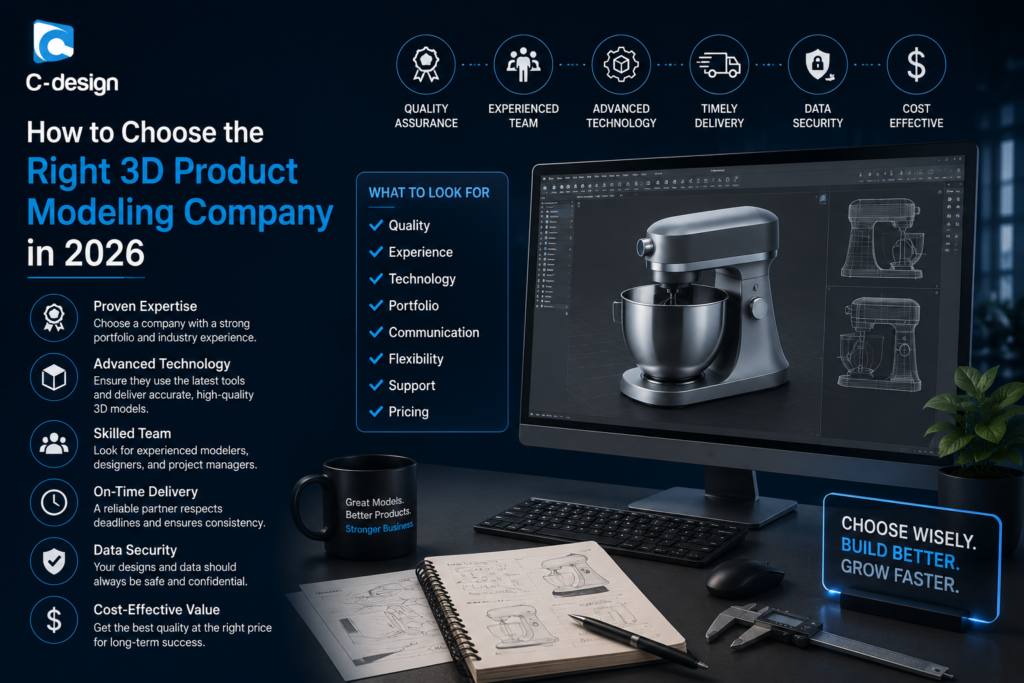
How to Choose the Right 3D Product Modeling Company in 2026

How to Choose the Right 3D Product Modeling Company in 2026


In 2026, 3D product modeling is no longer a luxury. It is a necessity for brands that want to showcase products online, support AR experiences, create marketing visuals, or prepare for manufacturing. But with so many service providers available, choosing the right 3D product modeling company can be overwhelming.

The wrong choice can lead to inaccurate models, missed deadlines, poor communication, and wasted budget. The right choice can accelerate your product launches, improve marketing quality, and reduce long-term costs. That is why having a clear buyer's checklist is essential.

For businesses that want reliable, high-quality results, Outsource 3D Modeling offers a trusted solution. With years of experience in 3D product design, modeling accuracy, and large catalog handling, the company helps brands move from concept to production-ready assets with confidence.

This guide breaks down exactly what to look for when you outsource 3D modeling services, with a practical, 10-point buyer's checklist you can use to evaluate any vendor — including us, Outsource3DModeling.com.

Why Choosing the Right 3D Modeling Partner Matters in 2026

The 3D content industry has matured fast. AI-assisted rendering, real-time engines, AR shopping on Instagram and Amazon, and virtual showrooms have turned 3D assets from a marketing extra into a core sales tool. At the same time, hundreds of freelancers and agencies now claim to offer "professional 3D modeling services," making it harder than ever to separate real expertise from inflated portfolios.

Choosing poorly costs more than money. It costs time-to-market, brand credibility, and customer trust — especially when a product's 3D model doesn't match its real-world dimensions, materials, or colors. Below is the checklist we recommend every business run through before signing a contract.


The 10-Point Buyer's Checklist for Choosing a 3D Product Modeling Company

Use this checklist to score potential vendors objectively. A strong partner should check every box below — not just one or two.

1. Industry Experience

Experience is more than "years in business." Ask potential vendors how many products they've modeled, which industries they specialize in, and whether they've handled projects similar in scale and complexity to yours. A company with deep experience in furniture 3D modeling, for example, will understand fabric draping, wood grain, and joinery details far better than a generalist studio.

  • Ask: "How many SKUs have you modeled in my product category?"
  • Ask: "Can you share client references or case studies?"

2. Portfolio & Niche Relevance

A strong portfolio tells you more than a sales pitch ever could. Look beyond polish — check for consistency across multiple products, accurate material rendering (glass, leather, metal, fabric), and evidence that the company can replicate your brand's visual style at scale.

  • Request samples specific to your product category, not just generic 3D art.
  • Check if lighting, shadows, and material finishes look photorealistic across different lighting setups.
  • Look for consistency — every product in a catalog should feel like it belongs to the same visual family.

3. Modeling Accuracy

Accuracy is where most low-cost vendors fail. A 3D product model must match the real product's exact dimensions, proportions, textures, and colors — especially for e-commerce, where inaccurate visuals lead to returns and lost customer trust. Ask how the company verifies measurements: do they work from CAD files, technical drawings, spec sheets, or multi-angle reference photography?

  • Confirm whether they can model from photographs alone or require CAD/technical references.
  • Ask about their internal QA/QC process before final delivery.
  • Request a test model or pilot SKU before committing to a full catalog.

4. Software Expertise

The right software stack affects both quality and compatibility with your existing pipeline. A capable 3D modeling company should be fluent across multiple tools and file formats so your models integrate smoothly into your website, AR platform, or rendering pipeline.

  • Modeling: 3ds Max, Maya, Blender, ZBrush, SolidWorks, Rhino
  • Rendering: V-Ray, KeyShot, Corona, Arnold
  • File formats: OBJ, FBX, GLTF/GLB, USDZ, STEP, STL — critical for AR/VR and web viewers

5. Turnaround Time

Speed matters, but not at the cost of accuracy. Ask for a realistic per-SKU turnaround estimate and how that scales for bulk orders. A dependable partner will be upfront if a rush request compromises quality, rather than overpromising and under-delivering.

  • Get turnaround estimates in writing, including for large batch orders.
  • Ask how they handle urgent or rush requests, and whether that affects pricing.

6. Revision Policy

Even the best briefs need refinement. A transparent revision policy protects you from unexpected costs later. Look for a clearly stated number of included revision rounds, a simple feedback process, and reasonable turnaround for revised files.

  • How many revision rounds are included in the base price?
  • What is the process for submitting feedback (markup tools, calls, tickets)?
  • Are revisions delivered within a guaranteed timeframe?

7. Confidentiality & Data Security

If you're modeling unreleased products, prototypes, or proprietary designs, confidentiality is non-negotiable. A trustworthy 3D modeling company should offer a signed Non-Disclosure Agreement (NDA), secure file-sharing channels, and clear policies on data retention and deletion after project completion.

  • Is an NDA offered and signed before any files are shared?
  • How are source files, CAD data, and reference images stored and protected?
  • What happens to your files after the project is completed?

8. Transparent Pricing

Pricing should be easy to understand and scale predictably. Watch out for vague quotes that don't break down cost per SKU, complexity tier, or revision. The best vendors offer tiered pricing based on model complexity (low-poly vs. photorealistic) and volume discounts for large catalogs.

  • Request an itemized quote broken down by SKU, complexity, and add-ons (animation, AR-ready formats, etc.).
  • Ask about volume discounts for bulk or recurring catalog work.
  • Confirm there are no hidden charges for file format conversions or revisions.

9. Communication

Time zones, language barriers, and unclear project management can derail even the most talented 3D team. Prioritize vendors who assign a dedicated project manager, provide regular status updates, and are responsive across your preferred communication channels — email, chat, or video calls.

  • Is there a single point of contact for your account?
  • What tools are used for project tracking and file sharing?
  • How quickly do they typically respond to questions or issues?

10. Ability to Handle Large Product Catalogs

If you sell hundreds or thousands of SKUs, scalability is essential. Ask about the size of the production team, their capacity for parallel workflows, and how they maintain consistent quality and style across an entire catalog — not just a handful of hero products.

  • Can they commit to recurring monthly or quarterly catalog updates?
  • Do they use standardized templates or style guides to keep large catalogs visually consistent?
  • What is their maximum monthly production capacity?

Why Outsourcing 3D Modeling Makes Sense

Outsourcing 3D product modeling offers several advantages:

  • Cost efficiency: Pay only for what you need without hiring full-time staff.
  • Access to expertise: Work with specialists who focus on 3D modeling daily.
  • Scalability: Scale up or down based on project needs.
  • Faster delivery: Dedicated teams can complete work faster.
  • Focus on core business: Free internal teams to focus on strategy and growth.

These benefits make outsourcing a practical way to build a strong 3D asset library.

Common Use Cases

Brands use 3D product modeling for many purposes:

  • E-commerce product pages and 360-degree views.
  • AR and VR experiences for marketing and sales.
  • Configurable product viewers on websites.
  • Marketing renders and advertising visuals.
  • Manufacturing and engineering documentation.
  • Packaging and label design support.

In each case, having accurate, high-quality 3D models improves results and reduces costs.

The Future of 3D Product Modeling

The demand for 3D product assets will only continue to grow. As AR, VR, and interactive experiences become more common, brands will need more 3D content to stay competitive.

Companies that invest in 3D modeling now will be better positioned for:

  • Immersive shopping experiences.
  • Digital twins and product simulations.
  • AI-driven visualization and automation.
  • Global e-commerce expansion.

Choosing the right 3D modeling partner today is a strategic move for future growth.


Why Outsource3DModeling.com Checks Every Box

At Outsource3DModeling.com, we built our entire workflow around this exact checklist, because we know it's how serious buyers evaluate 3D modeling partners. Here's how we stack up:

  • Proven Experience Across Industries: Our team has modeled products across furniture, jewelry, apparel, footwear, electronics, industrial equipment, and more — so we understand the nuances of your specific category.

  • A Portfolio Built on Photorealism: Every project showcases accurate materials, lighting, and proportions, giving you confidence before you commit.

  • Dimensional Accuracy, Guaranteed: We work from CAD files, spec sheets, or multi-angle photography and run every model through internal QA before delivery.

  • Full-Stack Software Expertise: Our artists work fluently across 3ds Max, Maya, Blender, ZBrush, KeyShot, and V-Ray, delivering files in OBJ, FBX, GLTF/GLB, USDZ, and more for web, AR, and print.

  • Fast, Reliable Turnaround: Clear timelines for single SKUs and bulk catalogs alike, with rush options when you need them.

  • Fair, Transparent Revision Policy: Multiple included revision rounds with a simple feedback process, so you get it right without surprise fees.

  • Strict Confidentiality: NDAs, secure file transfer, and strict data handling policies protect your unreleased and proprietary products.

  • Transparent, Scalable Pricing: Itemized quotes and volume discounts designed for both single-product brands and large retailers.

  • Responsive Communication: A dedicated project manager and regular updates keep you informed at every stage.

  • Built for Large Catalogs: A scalable production pipeline capable of modeling hundreds to thousands of SKUs with consistent style and quality, on recurring schedules.

In short, we don't just meet the checklist — we built our process around it, so brands and retailers can outsource 3D modeling with confidence instead of guesswork.

Ready to See the Difference the Right 3D Modeling Partner Makes?

Whether you need a single hero product or a catalog of 10,000 SKUs, our team is ready to help you launch stunning, accurate 3D models.

👉 Request a Free 3D Modeling Quote

Final Thoughts

Choosing the right 3D product modeling company in 2026 comes down to one thing: proof, not promises. Use the 10-point checklist above — experience, portfolio, accuracy, software expertise, turnaround, revisions, confidentiality, pricing, communication, and catalog scalability — to evaluate any vendor objectively before you sign a contract.

If you're ready to work with a team that checks every box, Outsource3DModeling.com is ready to bring your products to life in stunning, accurate 3D.

👉 Request a Free 3D Modeling Quote Today


Frequently Asked Questions (FAQs)

1. How much does it cost to outsource 3D product modeling?

Pricing typically depends on model complexity, level of realism required, and order volume. Simple low-poly models cost less than photorealistic, animation-ready assets. Most 3D modeling companies, including ours, offer tiered pricing and volume discounts for large catalogs — always request an itemized quote before starting.

2. How long does it take to create a 3D product model?

A single, moderately detailed product model usually takes a few business days, while photorealistic or highly complex models can take longer. Bulk catalog projects are typically scheduled in batches with clear weekly or monthly delivery targets.

3. What files do I need to provide to get an accurate 3D model?

The more reference material you provide, the more accurate the result. Ideal inputs include CAD files or technical drawings, multi-angle photographs, material swatches, and exact measurements. If CAD isn't available, an experienced studio can still model accurately from detailed photos and specs.

4. Can a 3D modeling company handle my entire product catalog, not just a few items?

Yes — established studios build scalable production pipelines specifically for large catalogs, using standardized style guides to keep hundreds or thousands of SKUs visually consistent. Ask any vendor directly about their maximum monthly production capacity before signing on.

5. Will my product designs stay confidential?

A reputable 3D modeling partner will sign an NDA before any files are shared and follow strict data protection practices, including secure transfer and controlled file retention. Always confirm confidentiality terms in writing before sending proprietary designs.

6. What file formats will I receive for my 3D models?

Common deliverables include OBJ, FBX, GLTF/GLB (for web and AR), USDZ (for iOS AR), and STL or STEP for manufacturing use cases. Confirm the formats you need upfront, especially if you're integrating models into a specific e-commerce platform or AR tool.

7. How do I know if a 3D model is accurate before it goes live on my website?

Reliable vendors include a quality assurance step that checks proportions, dimensions, textures, and colors against reference materials before delivery. You should also request a pilot model or test SKU first to validate accuracy before committing to a full catalog.

Tags

3D Product Modeling | Outsource 3D Modeling | 3D Modeling Company | E-commerce 3D Models | Product Visualization | CAD Modeling Services | 3D Rendering Services | AR/VR Product Models | Photorealistic 3D Models | 3D Modeling for Large Catalogs | Choose 3D Modeling Company 2026