How Outsourcing 3D Modeling Helps Businesses Reduce Production Bottlenecks | Outsource 3D Modeling
Every business that relies on 3D content eventually faces the same challenge: too many assets, too little time and limited internal capacity. Product launches are delayed, marketing campaigns wait for renders, e-commerce catalogs remain incomplete, and design teams spend more time managing production than creating value.
This is where outsourcing 3D modeling becomes a practical solution. Instead of hiring permanent 3D artists for every workload peak, businesses can access skilled external teams to create models, renderings, textures, animations and AR/VR assets on demand.
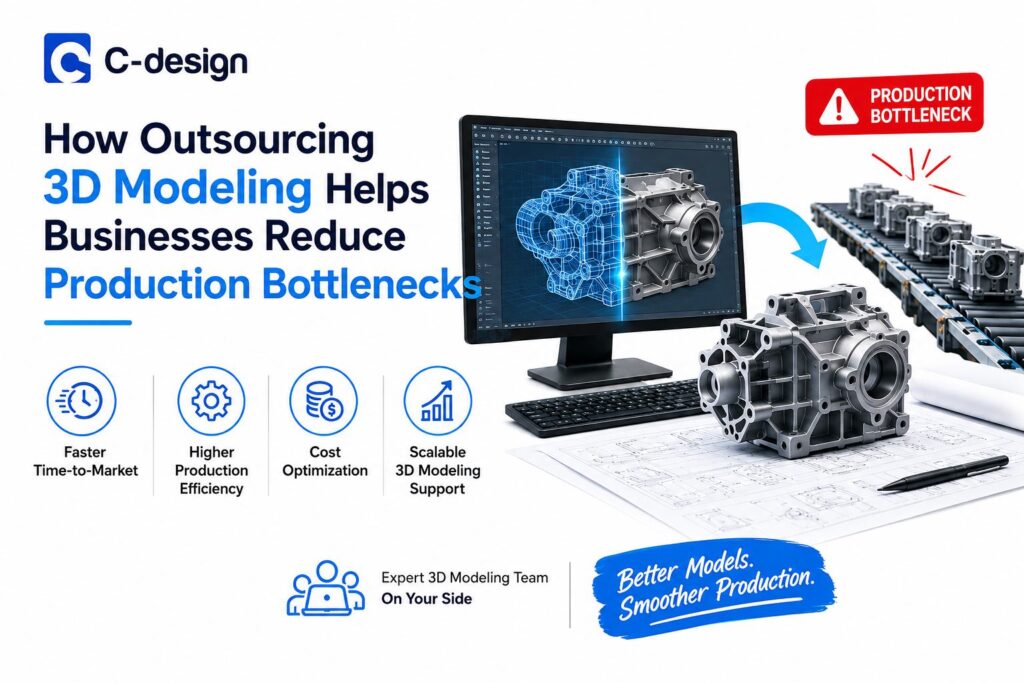
Outsourcing 3D modeling helps businesses reduce production bottlenecks by adding flexible capacity, improving workflow efficiency, maintaining quality and accelerating delivery. It allows companies to scale 3D production without expanding their internal teams or investing in every specialist role, software licence and workstation.
Outsource 3D Modeling provides 3D product modeling, furniture modeling, rendering, texturing, animation, AR/VR assets and related visualization services. The company helps businesses manage high-volume 3D production, tight deadlines and changing project requirements through structured external production support.
What Is a 3D Production Bottleneck?
A production bottleneck occurs when the demand for 3D assets exceeds the capacity of the team responsible for creating them.
For example, a furniture brand may need hundreds of product models for an e-commerce catalog. A manufacturer may need product visualizations for a launch. An architecture firm may need renders, walkthroughs and AR assets for a client presentation. A game studio may need environments, props and characters for an upcoming release.
If the internal team cannot produce these assets quickly enough, the entire project slows down.
A 3D production bottleneck can happen because of:
- Tight deadlines.
- Limited in-house 3D artists.
- Increasing project demands.
- Complex modelling requirements.
- A shortage of specialist skills.
- Limited software or hardware capacity.
- Frequent design revisions.
- Poor asset planning.
- A lack of quality-control processes.
- Seasonal demand spikes.
The result is often the same: delayed launches, incomplete catalogs, rushed visuals, higher stress and missed business opportunities.
Why 3D Demand Keeps Increasing
Businesses need more 3D content than ever before. A single 3D model may now be used across multiple channels and formats.
A product model may be needed for:
- E-commerce product pages.
- 360-degree product viewers.
- Marketing renders.
- Social-media campaigns.
- Product configurators.
- AR placement experiences.
- VR showrooms.
- Training and instructional content.
- Sales presentations.
- Digital catalogs.
This means that one product may require several versions: a high-resolution render, a web-optimised model, an AR-ready asset and an animation-ready file. Creating all of these internally can quickly overwhelm a small team.
Outsourcing 3D modeling allows businesses to meet this demand without treating every new asset requirement as a reason to hire more permanent staff.
How Outsourcing Removes Production Bottlenecks
Outsourcing 3D modeling helps businesses overcome bottlenecks by providing additional capacity exactly when it is needed.
Instead of waiting for an internal artist to become available, a business can assign a defined batch of work to an external team. This allows production to continue in parallel while internal staff focus on design direction, product knowledge, approvals and strategic work.
For example, an internal team may handle concept development, product references and final approval, while an external team creates base models, applies materials, develops textures, prepares renders and optimises assets for AR or e-commerce.
This division of work reduces delays because multiple tasks can move forward at the same time.
Access Skilled 3D Artists Quickly
One of the biggest causes of production bottlenecks is the shortage of skilled 3D artists. Businesses may need a product modeller, texture artist, rendering specialist, animator or AR/VR developer, but hiring each role internally takes time and money.
Outsourcing gives businesses access to a wider talent pool. Instead of recruiting for every skill, they can work with a team that already has experience across different 3D disciplines.
Outsource 3D Modeling provides services including 3D product modelling, furniture modelling, game models, character modelling, digital sculpting, texturing, rendering, animation and AR/VR asset creation.
This breadth of capability is valuable because businesses can use one partner for multiple asset types instead of building a new internal team for every requirement.
Scale Production Without Expanding Headcount
Business demand does not remain constant. A company may need only a few models one month and hundreds the next.
Hiring permanent 3D artists for every peak creates a problem: when demand falls, the business still carries salaries, benefits, software costs and management overhead. Outsourcing solves this by making capacity flexible.
A business can increase external production capacity during a product launch, seasonal campaign or catalog expansion. When the workload reduces, it can scale back without the cost and complexity of permanent hiring.
Outsourcing 3D modeling is therefore not just a way to get more assets made. It is a way to build a more flexible production model.
Outsource 3D Modeling describes outsourcing as a way for businesses to access professional expertise, advanced technology, faster production and cost-effective solutions.
Improve Workflow Efficiency
A production bottleneck is not always caused by a lack of artists. Sometimes it is caused by an inefficient workflow.
Without clear briefs, asset standards, file structures and review processes, even a skilled team can become delayed. Artists may wait for references, recreate existing assets, use inconsistent naming or produce files that need significant correction.
A structured outsourcing partner can improve workflow efficiency by introducing:
- Clear asset briefs.
- Standardised naming conventions.
- Defined file formats.
- Reusable templates.
- Batch production schedules.
- Quality-control checkpoints.
- Revision-management processes.
- Centralised asset libraries.
Outsource 3D Modeling describes a workflow that includes asset planning, prioritisation, modular batch schedules and artist allocation by product category and complexity.
This approach helps businesses move from ad-hoc production to a repeatable 3D asset pipeline.
Reduce Production Costs Intelligently
Outsourcing 3D modeling can reduce costs, but the goal should be intelligent cost reduction rather than simply choosing the cheapest option.
Maintaining an internal 3D team requires salaries, recruitment, training, software licences, high-performance hardware, rendering infrastructure and management time. These costs remain even when demand is low.
Outsourcing allows businesses to convert some fixed costs into flexible project costs. Instead of paying for permanent capacity, they pay for the assets and production support they need.
Outsource 3D Modeling highlights that outsourcing can help businesses eliminate recruitment costs, avoid infrastructure investment and reduce software-licensing burdens.
However, cost savings should not come at the expense of quality. A low-cost model that is inaccurate, poorly optimised or unusable can create more expense through revisions, delays and rework.
Maintain Quality While Scaling
A common concern about outsourcing is quality. Businesses worry that external teams may not understand their products, brand standards or technical requirements.
This risk can be reduced with a clear brief, reference package, quality checklist and review process. A good outsourcing partner should ask questions before production begins rather than making assumptions.
Quality control should include:
- Accurate dimensions and proportions.
- Correct topology and geometry.
- Appropriate polygon counts.
- Clean UV mapping.
- Reliable materials and textures.
- Correct naming conventions.
- Platform-specific optimisation.
- Review of renders and final files.
- Controlled revisions.
Outsource 3D Modeling describes a structured production process that includes quality-assurance workflows, dedicated revision cycles and optimisation for real-time AR/VR deployment.
This approach helps businesses scale production without sacrificing consistency or quality.
Accelerate Project Delivery
Speed is one of the main reasons businesses outsource 3D modeling. When internal capacity is limited, projects can wait in a queue. When external capacity is available, production can begin sooner.
Outsourcing also allows work to be divided into parallel streams. One artist may create base geometry while another prepares materials, textures or renders. A project manager can coordinate batches, track progress and manage revisions.
This parallel production approach is especially useful for large catalogs, product families, game assets, architectural visualisation and AR/VR projects.
Outsource 3D Modeling describes high-volume 3D product modelling workflows that use batch schedules and artist allocation by product category and complexity.
The result is faster delivery without asking an internal team to work beyond its capacity.
Support High-Volume 3D Production
Some businesses do not need one model. They need hundreds or thousands.
An e-commerce retailer may need a complete product catalog. A furniture brand may need every fabric, finish and configuration modelled. A manufacturer may need product families and variants. A game studio may need environments, props and characters.
Managing this volume internally can be difficult. It requires not only artists, but also project management, quality control, file management and technical optimisation.
Outsourcing 3D modeling helps businesses manage high-volume production through batch planning, standardised workflows and dedicated production teams.
Outsource 3D Modeling describes support for high-volume 3D product modelling, including modular batch schedules and artist allocation by product category and complexity.
This makes it easier for businesses to launch complete catalogs rather than only a small selection of best-selling products.
Support Multiple 3D Formats and Platforms
A 3D asset is rarely used in only one format. A product model may need to work across e-commerce, marketing, AR, VR, animation and interactive experiences.
Each format has different requirements. A high-resolution render may need detailed geometry and textures. A web model may need to be lightweight. An AR asset may need to be optimised for real-time performance. A VR experience may require careful scale, navigation and interaction design.
Outsourcing gives businesses access to specialists who understand these differences.
Outsource 3D Modeling provides AR/VR asset optimisation and supports formats such as USDZ and GLB for real-time deployment.
This helps businesses avoid creating separate internal teams for rendering, web optimisation, AR and VR.
Free Internal Teams for Higher-Value Work
When internal teams are constantly producing 3D assets, they may have little time for strategic work.
Designers may spend more time modelling than improving products. Marketers may spend more time chasing renders than planning campaigns. Product managers may spend more time tracking files than improving customer experience.
Outsourcing helps businesses redirect internal talent toward higher-value activities:
- Product innovation.
- Brand strategy.
- Customer experience.
- Creative direction.
- Quality approval.
- Market expansion.
- Business development.
The goal is not to remove internal teams. It is to allow them to focus on the work that creates the most value.
Handle Revisions More Efficiently
Revisions are a normal part of 3D production. A client may request a different colour, material, camera angle, lighting setup or product variation.
Without a clear revision process, these requests can create delays and confusion. An external team can help manage revisions more efficiently through version control, clear feedback and structured approval steps.
A good outsourcing partner should distinguish between a simple production change and a change that affects the overall design. It should also identify missing information rather than making assumptions.
This reduces the risk of repeated revisions and helps projects move forward more smoothly.
Improve Asset Consistency
Consistency is essential for brands that produce large volumes of 3D content. If every model uses different materials, naming conventions or file structures, the asset library becomes difficult to manage.
Outsourcing can improve consistency by applying the same standards across every asset.
A structured 3D asset pipeline should include:
- Standard naming conventions.
- Consistent material libraries.
- Controlled texture sizes.
- Defined polygon limits.
- Approved file formats.
- Standard lighting setups.
- Quality-control checklists.
- Reusable asset templates.
This makes it easier to scale production while maintaining a consistent brand experience.
How Outsource 3D Modeling Helps Businesses
Outsource 3D Modeling helps businesses overcome 3D production bottlenecks by providing skilled external teams, flexible capacity and structured production workflows.
The company offers 3D product modelling, furniture modelling, game models, character modelling, digital sculpting, texturing, rendering, animation and AR/VR asset creation.
This allows businesses to access specialist capabilities without building every role internally.
Flexible Production Capacity
Outsource 3D Modeling can support businesses during product launches, seasonal campaigns, catalog expansions and high-volume asset requirements. This helps companies scale production without expanding permanent headcount.
Specialist 3D Talent
The company provides access to 3D artists and specialists across product modelling, furniture modelling, rendering, texturing, animation and AR/VR.
High-Volume Production Support
Outsource 3D Modeling describes workflows for high-volume 3D product modelling, including batch planning and artist allocation by product category and complexity.
Quality-Focused Workflows
The company describes quality-assurance workflows, dedicated revision cycles and optimisation for real-time AR/VR deployment.
Multi-Format Delivery
Outsource 3D Modeling supports 3D models, renderings, animations and AR/VR assets, including formats such as USDZ and GLB for real-time use.
Reduced Internal Overhead
By outsourcing, businesses can avoid recruitment costs, infrastructure investment and software-licensing burdens.
A Practical Example
Consider a furniture brand preparing to launch a new collection online. It needs product models, material variations, studio renders, lifestyle scenes and AR-ready assets.
Its internal team can manage product references and approvals, but it cannot create every model and render before the launch date.
Instead of delaying the launch, the brand outsources a defined batch of work. The external team creates base models, applies approved materials, prepares renders and optimises AR assets. The internal team reviews outputs, provides feedback and approves final files.
The result is a complete catalog delivered on time, without hiring permanent 3D artists for a temporary workload peak.
How to Start Outsourcing 3D Modeling
A successful outsourcing relationship starts with a clear brief. Businesses should prepare the information an external team needs to understand the project.
- Define the objective: e-commerce, marketing, AR/VR, animation, product design or another use.
- Share product references: CAD files, drawings, photos, dimensions and material samples.
- Confirm technical requirements: file formats, polygon limits, texture sizes and platform requirements.
- Set quality expectations: provide approved examples and define review criteria.
- Agree milestones: set batch schedules, review dates and delivery deadlines.
- Establish revision rules: clarify who provides feedback and how changes are approved.
- Start with a pilot: test a small batch before committing to a larger production program.
A pilot project helps businesses test quality, communication and workflow fit before scaling.
Common Mistakes to Avoid
Businesses can avoid outsourcing problems by avoiding these common mistakes:
- Choosing a provider based only on price.
- Providing incomplete references or unclear briefs.
- Failing to define technical requirements.
- Not setting quality standards.
- Allowing uncontrolled revisions.
- Treating outsourcing as a one-time solution rather than a production system.
- Failing to review outputs before final delivery.
- Not building reusable asset libraries.
- Assuming every 3D asset needs the same level of detail.
A successful outsourcing partnership is built on clear communication, defined standards and shared quality expectations.
The Future of 3D Modeling Outsourcing
The future of 3D modeling outsourcing will be shaped by AI, automation and structured production systems. AI can support early concepts, rough geometry, texture exploration and repetitive tasks. However, skilled 3D artists remain essential for accuracy, creativity, optimisation and final quality control.
Businesses that combine external talent with clear workflows will be able to produce more 3D content, respond faster to market changes and scale without expanding fixed overhead.
Outsourcing 3D modeling is not about replacing internal teams. It is about giving them the capacity, specialist skills and production support they need to deliver more value.
SEO Keywords
Frequently Asked Questions
1. What is outsourcing 3D modeling?
Outsourcing 3D modeling means engaging an external team to create 3D models, renderings, textures, animations or AR/VR assets for a business. It allows companies to access specialist capacity without hiring permanent in-house artists.
2. How does outsourcing 3D modeling reduce production bottlenecks?
It provides additional capacity during busy periods, allowing businesses to produce assets in parallel, manage high-volume workloads and avoid delays caused by limited internal resources.
3. Which businesses benefit from 3D modeling outsourcing?
Product brands, furniture companies, manufacturers, retailers, architects, real-estate firms, game studios, e-commerce businesses and AR/VR developers can all benefit from outsourcing 3D modeling.
4. Can outsourcing maintain quality?
Yes, when the project includes clear briefs, reference materials, technical requirements, quality checklists and structured review processes. A good outsourcing partner should identify missing information rather than making assumptions.
5. Does outsourcing 3D modeling reduce costs?
It can reduce fixed costs related to hiring, training, software, hardware and rendering infrastructure. However, the best results come from balancing cost with quality, accuracy and reliable delivery.
6. What types of 3D assets can be outsourced?
Businesses can outsource product models, furniture models, architectural models, game assets, characters, textures, renderings, animations, AR/VR assets and interactive 3D content.
7. How can Outsource 3D Modeling help my business?
Outsource 3D Modeling provides 3D product modelling, furniture modelling, rendering, texturing, animation and AR/VR asset creation. It helps businesses manage high-volume production, tight deadlines and changing project requirements.
Remove Production Bottlenecks. Scale Your 3D Content.
Your business should not have to delay a product launch, campaign or catalog because internal 3D capacity is limited. Outsourcing 3D modeling gives you access to skilled artists, flexible production capacity and structured workflows that help you deliver high-quality assets faster.
Outsource 3D Modeling helps businesses reduce production bottlenecks through 3D product modelling, furniture modelling, rendering, texturing, animation and AR/VR asset creation.
From a single hero product to a high-volume catalog, our team can support your 3D production needs while maintaining quality, consistency and deadline control.
Ready to remove 3D production bottlenecks and scale your content delivery?
Visit www.outsource3dmodeling.com to request a consultation or discuss your next 3D modeling project with our experts.
Tags