OUTSOURCE CREATIVE SERVICES - OUTSOURCE CREATIVE WORKS-OUTSOURCING CREATIVE WORK - OUTSOURCE CREATIVE DESIGN -OUTSOURCE 2D ARTWORKS - 2D ART SERVICES - 2D ART OUTSOURCING -ART OUTSOURCING - OUTSOURCE ILLUSTRATION WORKS - OUTSOURCE ILLUSTRATION SERVICES - OUTSOURCE 3D MODELING - 3D MODEL OUTSOURCING- OUTSOURCING CAD WORKS- OUTSOURCE ARCHITECTURAL SERVICES -BIM - REVIT - 3D FLOOR PLAN - BIM OUTSOURCING SERVICES - MEP - REVIT MODELING - 3D FURNITURE MODELING - 3D ARCHITECTURE MODELING - AUGMENTED REALITY MODEL - VIRTUAL REALITY MODEL - 3D RENDERING - PRODUCT MODELING - 2D SERVICES - OUTSOURCE CREATIVE SERVICES -3D MODELING SERVICES - VFX
How AR-VR Workflows Depend on Outsource 3D Modeling Services
The digital landscape is currently undergoing its most significant evolution since the invention of the smartphone: the transition from flat, 2D screens to immersive, 3D spatial environments. Augmented Reality - Virtual Reality (AR/VR) technologies are no longer futuristic concepts reserved for science fiction; they are active, revenue-generating tools for retail, architecture, and manufacturing. However, as the demand for these experiences grows, a critical bottleneck has emerged—the creation of high-quality, optimized 3D content.
However, behind every seamless AR furniture placement or immersive VR architectural walkthrough lies a complex, high-stakes production pipeline. The "magic" of seeing a virtual product in your living room depends entirely on the quality and optimization of the underlying 3D assets. For most firms, trying to build these assets in-house creates a massive bottleneck. This is why the most successful digital strategies now depend on the decision to Outsource 3D Modeling services.
In this deep dive, we explore how immersive workflows are being transformed by specialized outsourcing, focusing on 3D Product Design, 3D Furniture Modeling, and the technical rigors of Texturing and 3D Rendering.
The Foundation of Immersion: 3D Modeling and Design
At its core, every AR and VR experience is only as good as the models that inhabit it. In a VR environment, if a chair looks like a cardboard box or a door handle lacks the correct metallic sheen, the user’s "sense of presence" is immediately broken. This psychological immersion is the "North Star" of immersive technology.
To achieve this, 3d modeling and design for AR/VR must go beyond simple aesthetics. Unlike static images used in traditional marketing, AR/VR models are interactive. Users can walk around them, zoom in on their textures, and even manipulate them. This requires a level of geometric precision and structural integrity that traditional graphic design does not demand.
Professional outsourcing firms, such as Outsource 3D Modeling, specialize in this technical "heavy lifting." They provide the foundational geometry that allows a digital asset to exist in a 3D space with real-world proportions and physical accuracy.
1. The Anatomy of an AR-VR Asset: The "Real-Time" Challenge
To understand why businesses choose to Outsource 3D Modeling services, we must first understand the unique technical requirements of AR and VR. Unlike 3D assets used for film or static marketing—which can take hours to render a single frame—AR and VR assets must be rendered in "real-time."
The Performance Balancing Act
In a VR headset like the Meta Quest or Apple Vision Pro, the system must render at least 72 to 90 frames per second (FPS) to prevent motion sickness. This means the 3D models must be incredibly "lightweight" (low polygon count) while still appearing hyper-realistic.
Professional outsourcing partners specialize in this balancing act. They take a high-fidelity 3D Product Design and "re-topologize" it—shrinking the data size without losing the visual detail. This technical optimization is the difference between a smooth, professional app and a laggy, unplayable experience.
2. Retail Revolution: Outsource 3D Furniture Modeling
The "View in Room" feature has become a global standard for e-commerce giants and boutique furniture brands alike. When a brand chooses to Outsource 3D Furniture Modeling, they are looking for more than just a digital replica; they need a "Digital Twin."
- Dimensional Accuracy: In Augmented Reality - Virtual Reality, the scale is 1:1. If a digital sofa is three inches longer than the physical one, the customer’s trust is broken. Outsourced experts ensure precision down to the millimeter.
- Material Fidelity: The sheen of leather, the grain of oak, or the weave of linen—these details are perfected through advanced Texturing.
- Massive Scalability: A retailer with 1,000 SKUs cannot wait years for an in-house team to model each piece. Specialized firms like Outsource 3D Modeling provide the "elasticity" to model entire catalogs in weeks.
3. The Role of 3D Architecture in Virtual Spaces
Real estate and architecture have moved beyond the "blueprints." Today, developers sell luxury condos and commercial spaces that haven't even broken ground.
Immersive Walkthroughs
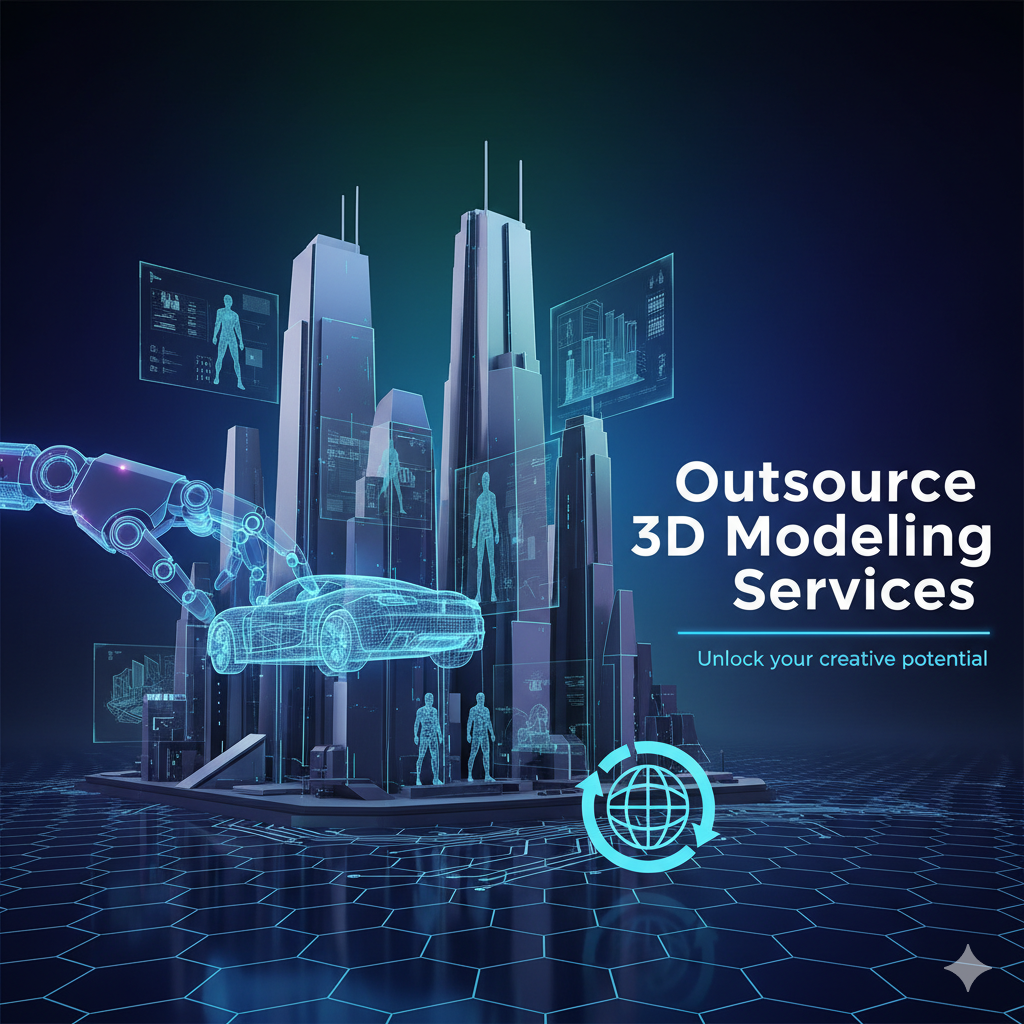
3D Architecture in VR allows a potential buyer to walk through a penthouse, look out the windows at a simulated view, and change the kitchen finishes with a click.
- Lighting and Atmosphere: Achieving this requires high-end 3D Rendering skills to simulate sunlight at different times of the day.
- Environmental Detail: Outsourcing firms provide the "props" (furniture, plants, people) that make a cold 3D model feel like a lived-in home.
5. The Technical Engine: Texturing and 3D Rendering
If geometry is the "body" of a 3D model, Texturing and 3D Rendering are the "skin" and the "soul."
The Rise of PBR (Physically Based Rendering)
Modern AR-VR workflows depend on PBR. This is a scientific approach to Texturing where materials are defined by their physical properties:
- Albedo: The raw color.
- Roughness: How light scatters.
- Metallic: How it reflects light.
Outsourcing partners specialize in creating these complex "map" sets, ensuring that your digital product looks consistent whether it’s viewed in a sun-drenched AR environment or a dimly lit VR room.
Real-Time vs. Offline Rendering
While AR-VR uses "Real-Time" rendering, brands still need "Offline" (high-quality) 3D Rendering for print ads and web hero shots. A professional Outsource 3D Modeling services partner provides a "Unified Asset" approach—one high-quality model that can be rendered for a billboard or optimized for a smartphone.
4. The Technical Workflow: Texturing and Rendering for Realism
The "magic" of AR-VR lies in the details. A model is just a gray wireframe until it undergoes specialized Texturing and 3D Rendering.
Physically Based Rendering (PBR)
Modern AR-VR depends on a workflow called PBR. This involves creating multiple "maps" for a single object:
- Albedo Map: The base color.
- Roughness Map: Dictates how shiny or matte a surface is.
- Normal Map: Simulates small bumps and dents without adding extra geometry.
When you Outsource 3D Modeling services, you are tapping into artists who use industry-standard tools like Substance Painter to "bake" these details. This ensures that a virtual chair reflects light exactly like a real one, maintaining the "presence" that makes VR effective.
5. Why Smart Businesses Choose to Outsource

I. Access to Niche Talent
The skills required for 3d modeling and design specifically for AR-VR are rare. It requires a mix of artistic flair and technical optimization knowledge. Outsourcing allows a company in New York to work with a specialized team that has 15+ years of experience in these niche spatial workflows.
II. Cost-Effective Technology
High-quality 3D production requires expensive software licenses (3ds Max, Maya, ZBrush) and high-performance render farms. By partnering with an external provider, businesses get the benefit of the latest technology without the massive upfront capital expenditure.
III. Faster Speed-to-Market
The immersive tech race is on. If a competitor launches an AR app first, they capture the market's attention. Outsourcing allows firms to scale their production "horizontally"—assigning more artists to a project instantly to meet aggressive deadlines.
6. Industrial and 3D Product Design
In industries like aerospace or healthcare, VR is used for safety training. These models require "mechanical precision." An outsourced team specializing in 3D Product Design can take raw CAD data from engineers and convert it into interactive, "explode-able" 3D models for training simulations. This allows technicians to learn how to repair a jet engine in a virtual space where mistakes cost nothing.
Conclusion: Building Reality, One Polygon at a Time
The future of business is three-dimensional. Whether it is through 3D Architecture, 3D Product Design, or Outsource 3D Furniture Modeling, the ability to create believable, optimized digital assets is the key to success in the AR-VR era.
The success of any Augmented Reality - Virtual Reality initiative boils down to the quality of the assets. A "glitchy," unoptimized 3D model doesn't just look bad; it breaks the user's immersion and damages your brand's reputation.
By choosing to Outsource 3D Modeling services, brands can access the specialized mastery of Texturing, the infinite scalability of Outsource 3D Furniture Modeling, and the technical precision of 3D Product Design. This isn't just about saving money; it’s about having the digital horsepower to lead your industry into the next dimension of commerce and design.
Frequently Asked Questions (FAQs)
1. Why can't I use my existing 3D marketing renders for AR-VR?
Marketing renders are usually "high-poly" and designed for quality over speed. They are far too complex for the real-time processing requirements of Augmented Reality - Virtual Reality. Professional 3d modeling and design services must "retopologize" these models to ensure they run smoothly on mobile devices.
2. What are the standard file formats for AR-VR?
The industry standard for Apple devices (iOS) is .USDZ, while the standard for Android and web-based AR is .GLB. A good outsourcing partner will provide your assets in both formats to ensure universal compatibility.
3. How does Texturing impact the AR experience?
In AR, the digital object must "sit" realistically in the real world. Advanced Texturing techniques (PBR) ensure the virtual object reacts to the actual lighting in your room—making a metal lamp look shiny or a fabric sofa look soft.
4. Is Outsource 3D Furniture Modeling cost-effective for small retailers?
Yes! Because you pay per asset, small retailers can digitize their best-selling items first without a massive upfront investment. This allows them to offer the same "high-tech" shopping experience as global brands.
5. Can 3D Architecture models be used for virtual tours?
Absolutely. By converting architectural CAD files into VR-ready models, developers can offer immersive 360-degree walkthroughs. This allows potential buyers to experience a space before construction even begins.
6. What information does an outsourcing partner need to start?
To provide accurate 3D Rendering and modeling, a partner usually needs high-resolution photos of the product from all angles, dimensions (height, width, depth), and physical material swatches (or high-res photos of them).
Ready to bring your products to life? Whether you need hyper-realistic 3D Product Design or scalable 3D Furniture Modeling, visit Outsource 3D Modeling today to transform your digital presence.
Outsource 3D Modelling Services


No comments:
Post a Comment