Why Global Companies Outsource 3D Modeling Services to Scale Faster
Published by C-Design | outsource3dmodeling.com
In the hyper-competitive landscape of modern commerce, speed and visual impact are no longer just advantages—they are prerequisites for survival. As businesses across the United States, United Kingdom, Germany, France, Australia, and New Zealand strive to capture consumer attention, the demand for high-quality, immersive visual content has skyrocketed. From photorealistic furniture catalogs to interactive virtual reality environments, 3D modeling has become the engine driving global brand growth. However, building an in-house team capable of handling the complexities of 3d modeling and design is often a bottleneck for scaling. This is why forward-thinking global companies are turning to Outsource 3D Modeling services to bridge the gap between vision and execution.
The Strategic Shift: Why Scaling Demands 3D Precision
The digital transformation of the last decade has fundamentally altered how products are designed, marketed, and sold. Whether it is a developer showcasing a new residential project through 3D Architecture or a manufacturer launching a new line of consumer electronics, the need for precision is absolute. Traditional 2D representations are no longer sufficient to meet the expectations of a global audience that demands interactivity and photorealism.
The Evolution of Visual Communication
We have transitioned from a world of static images to one of dynamic, interactive experiences. In the early days of the internet, a simple photograph was enough to sell a product. Today, consumers want to zoom in on the texture of a fabric, see how light reflects off a polished surface, and even "place" a piece of furniture in their living room using their smartphone. This shift is not just about aesthetics; it is about building trust. A high-quality 3D model provides a level of transparency that a 2D image cannot match. It says to the customer, "What you see is exactly what you will get." This psychological assurance is the foundation of modern e-commerce and high-ticket sales in industries like real estate and luxury goods.
The Scaling Bottleneck
For many companies, the internal resources required to manage 3D Rendering, Texturing, and complex modeling workflows are prohibitive. Scaling a business requires a rapid increase in content production without a proportional increase in overhead. If a company decides to launch 100 new products in a quarter, an in-house team of two or three designers will quickly become overwhelmed. This leads to delays, compromised quality, and missed market opportunities.
Furthermore, the management of a 3D department requires specialized knowledge. HR departments often struggle to vet 3D artists, and project managers may not understand the technical nuances of render times or topology. Outsourcing provides a flexible, on-demand solution that allows companies to focus on their core competencies—innovation and sales—while experts handle the technical heavy lifting. It removes the management burden and replaces it with a streamlined, results-oriented partnership.
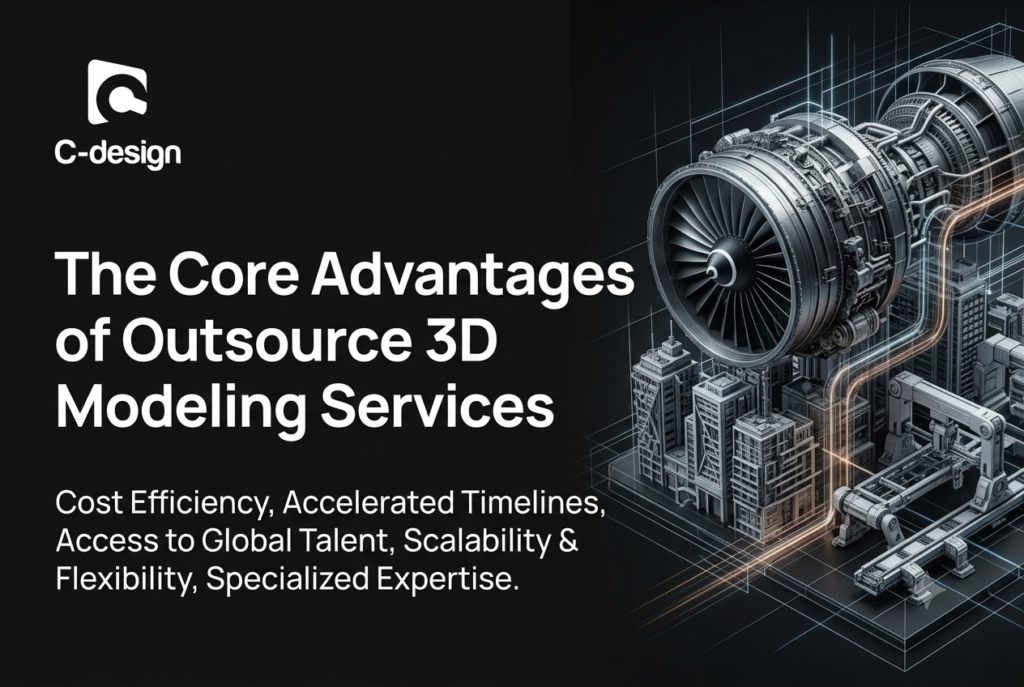
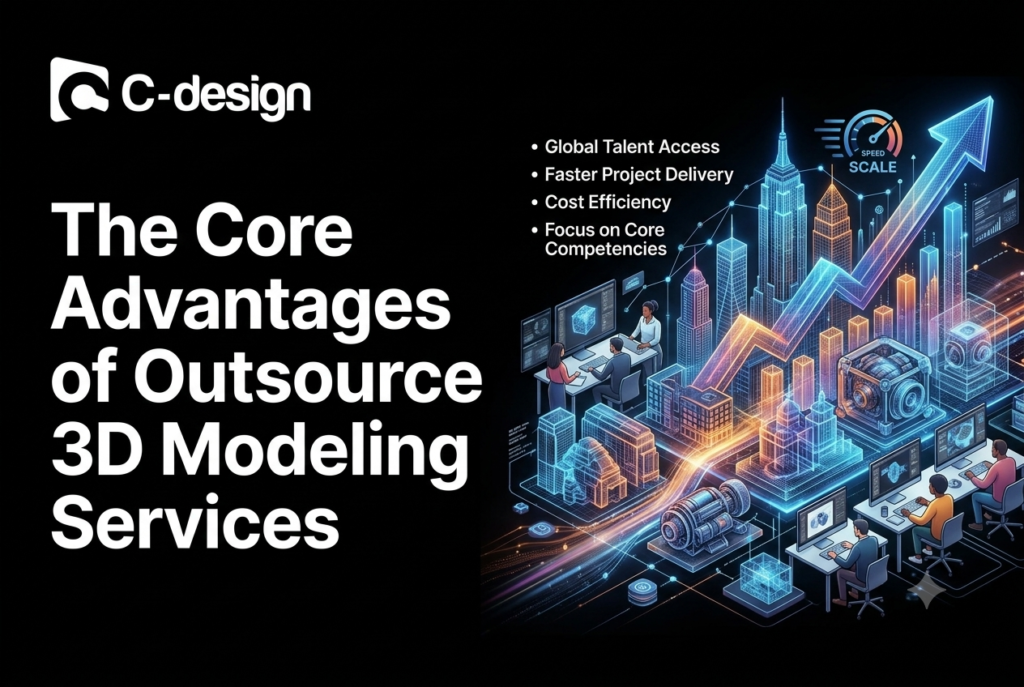
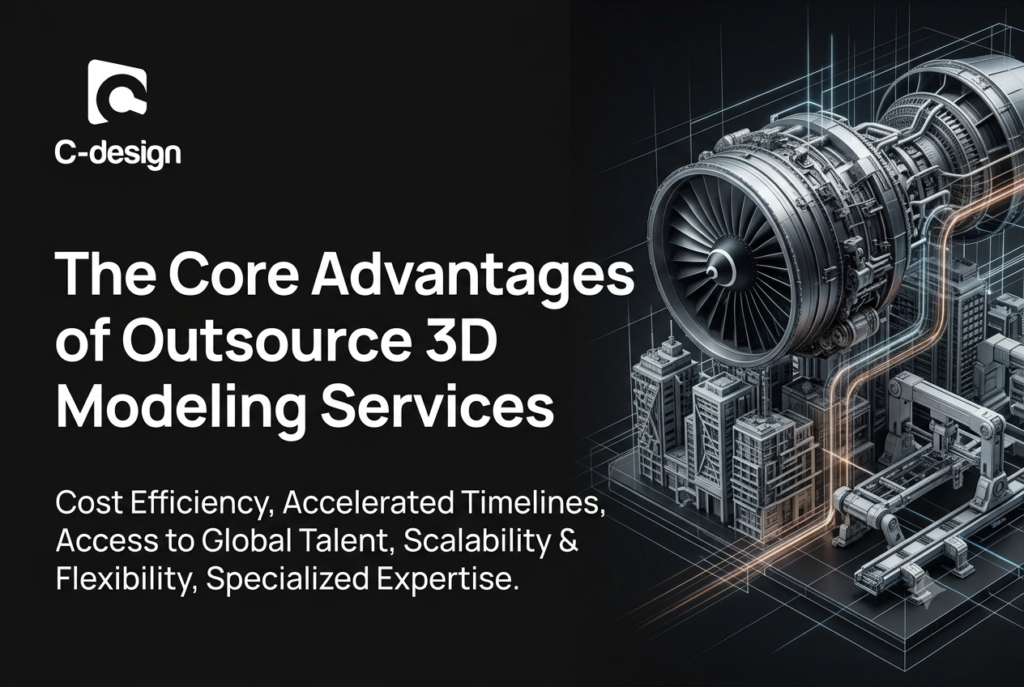
The Core Advantages of Outsource 3D Modeling Services
1. Drastic Reduction in Operational Costs
One of the most immediate benefits of choosing to Outsource 3D Modeling services is the cost advantage. Maintaining an in-house 3D department involves significant investment in high-end hardware (workstations with powerful GPUs), expensive software licenses (such as 3ds Max, Maya, or ZBrush), and the continuous training of staff to keep up with evolving technologies.
Beyond the equipment, the "hidden" costs of employment—benefits, office space, recruitment fees, and management time—add up quickly. In regions like the US or the UK, the salary of a senior 3D artist can be substantial. By outsourcing to a specialized partner like C-Design, companies can convert these fixed costs into variable expenses. You pay for what you need, when you need it. This financial agility is crucial for startups and established enterprises alike, especially when navigating the economic complexities of global markets. It allows for better capital allocation toward marketing and R&D.
2. Access to a Global Talent Pool
The expertise required for high-end 3D Product Design or intricate Texturing is highly specialized. A designer who is an expert in organic modeling for characters might not be the best fit for hard-surface modeling for industrial machinery. When you outsource, you are not limited by local talent availability or the specific skill set of your few in-house hires.
You gain access to a diverse team of professionals who have spent decades perfecting their craft. These experts understand the nuances of lighting, material properties, and geometric optimization. They stay updated on the latest industry trends, such as AI-assisted texturing or real-time rendering engines like Unreal Engine 5. This ensures that every model is not just a digital asset but a work of art that meets international standards. This "brain trust" becomes an extension of your own team, bringing a wealth of experience from hundreds of different projects across various industries.
3. Accelerated Time-to-Market
In industries like fashion, furniture, and technology, being first to market is critical. The "window of opportunity" is often narrow. Outsource 3D Modeling services often operate across multiple time zones, enabling a "follow-the-sun" workflow. While your local team in New York or London finishes their day, your outsourcing partner in another part of the world is just starting.
This round-the-clock productivity significantly shortens project timelines. What might take an in-house team three weeks to complete can often be delivered in one week by a dedicated outsourcing partner. This speed allows for faster product launches, more agile marketing campaigns, and the ability to respond instantly to competitor moves. In the digital age, speed is often the difference between winning a market and being an also-ran.
4. Scalability and Flexibility on Demand
Business cycles are rarely linear. A company might have a massive requirement for 500 models during a seasonal product launch and only 10 models during a quiet period. An in-house team is difficult to scale up or down quickly. Hiring new staff takes months, and letting people go is costly and damaging to morale.
Outsourcing partners provide the elasticity needed to handle large-scale projects at a moment's notice. Whether you need a single prototype or a massive library of 1,000 SKUs, a partner like C-Design can allocate the necessary resources to meet your deadline. This flexibility is a key driver for global companies looking to remain lean while growing fast. It allows you to say "yes" to big opportunities without worrying about whether your team can handle the workload.
Deep Dive: Outsource 3D Furniture Modeling
The furniture industry has been one of the biggest beneficiaries of the 3D revolution. Traditional furniture photography is notoriously expensive and logistically challenging. Shipping large items to a studio, setting up elaborate environments, and hiring photographers can cost thousands of dollars per item. If a sofa comes in 20 different fabric options, photographing every single one is practically impossible.
By choosing to Outsource 3D Furniture Modeling, brands can create hyper-realistic digital twins of their entire catalog. These models can be placed in any virtual environment—from a modern loft in New York to a cozy cottage in the French countryside—without ever leaving the computer.
The Power of Photorealism in Furniture
Modern 3D Rendering and Texturing techniques have reached a point where digital models are indistinguishable from real photos. This allows furniture retailers to:
•Test new designs: Before committing to manufacturing, companies can showcase 3D models to focus groups or on social media to gauge interest. This "market validation" saves millions in failed product launches.
•360-Degree Views: Customers can rotate the product, seeing every angle, which significantly reduces the "uncertainty" that leads to abandoned carts.
•Interactive Configurators: Users can change fabrics, wood finishes, and hardware in real-time. This interactive experience keeps users on the site longer and increases conversion rates.
This level of detail is essential for attracting high-quality leads in competitive markets like Germany and Australia, where consumers value both aesthetics and technical precision. For a furniture manufacturer, the ROI on a 3D model is often realized after just a few sales, as it replaces the need for multiple photo shoots and physical samples. Furthermore, these models can be reused across print catalogs, social media, and television commercials, providing a consistent brand image.
The Frontier of Innovation: Augmented Reality - Virtual Reality
As we move further into the 2020s, the integration of Augmented Reality - Virtual Reality (AR/VR) is no longer a futuristic concept—it is a current marketing standard. Global companies are using AR to allow customers to "place" products in their homes via smartphone apps. VR is being used for immersive architectural walkthroughs, medical training, and industrial simulations.
The Technical Challenge of AR/VR
Creating assets for Augmented Reality - Virtual Reality requires a specific set of skills that differ from traditional rendering. Models must be optimized for real-time performance. A model used for a high-end print ad might have millions of polygons, but that same model would crash a smartphone app.
Outsourcing partners specialize in:
•Retopology: Converting high-poly "sculpts" into efficient low-poly models.
•PBR (Physically Based Rendering) Texturing: Ensuring that materials look realistic under any lighting condition in an AR environment.
•Baking: Transferring high-detail lighting and texture information onto simpler geometry to maintain visual quality while improving performance.
•Interactivity: Setting up models so they can be interacted with—doors opening, lights turning on, or materials changing at a touch.
By outsourcing these specialized workflows, companies can stay at the cutting edge of technology without needing to master the technical intricacies of AR/VR development internally. This is particularly important for brands in the US and UK that are competing in the "spatial computing" era.
Precision in 3D Architecture and 3D Product Design
In the world of real estate and industrial manufacturing, the stakes are high. 3D Architecture allows developers to sell a vision before the first brick is laid. It provides a tool for stakeholder approval, government compliance, and pre-sales marketing. Similarly, 3D Product Design enables engineers and marketers to visualize complex machinery or consumer electronics with absolute clarity.
3D Architecture: Visualizing the Future
For architects and property developers in Australia and New Zealand, 3D visualization is a critical part of the planning process. It allows them to:
•Analyze Light and Shadow: See how a building will interact with its environment at different times of the day, ensuring compliance with local regulations.
•Material Selection: Experiment with different facades, flooring, and interior finishes to find the most cost-effective and aesthetically pleasing combination.
•Virtual Walkthroughs: Give potential buyers a tour of an apartment that hasn't been built yet, securing pre-sales that fund the construction.
3D Product Design: From Concept to Reality
In manufacturing hubs like Germany and the US, 3D Product Design is used to bridge the gap between engineering and marketing. A 3D model can be used for:
•Prototyping: Identifying design flaws or ergonomic issues before physical production begins.
•Exploded Views: Showing the internal components of a complex machine for educational, repair, or marketing purposes.
•Global Consistency: Ensuring that a product looks the same in marketing materials across all regions, regardless of where the local marketing team is based.
The workflow for these services involves a meticulous process of conceptualization, modeling, texturing, and rendering. Outsourcing these tasks to a dedicated team ensures that the final output is of the highest professional standard, suitable for presentation to high-level investors and international clients.
The Workflow of a Professional 3D Project
Understanding the steps involved in a professional 3D project helps illustrate why specialized outsourcing is so valuable. It is not just about "drawing" on a computer; it is a complex engineering and artistic process.
Step 1: Conceptualization and Reference Gathering
The project begins with a deep dive into the client's requirements. This involves studying CAD drawings, blueprints, or even hand-drawn sketches. For 3D Furniture Modeling, it might involve analyzing physical samples of wood and fabric to ensure the digital version is an exact match.
Step 2: 3D Modeling (Geometry)
The "skeleton" of the object is created. This involves defining the shape using polygons. For 3D Architecture, this means building the walls, floors, and structural elements with mathematical precision. For 3D Product Design, it means capturing every curve and bevel of a physical product.
Step 3: Texturing and Shading
This is where the object gets its "skin." Artists apply digital materials that define how the surface looks and feels. Is it shiny? Is it rough? Does it have a grain? This step is critical for photorealism. Texturing involves complex maps—diffuse, normal, specular, and displacement—that work together to trick the eye into seeing depth and detail where there is only a flat surface.
Step 4: Lighting and Environment Setup
Just like a real-world photo shoot, a 3D scene needs light. Artists set up virtual lights—sunlight, spotlights, or ambient glow—to create the desired mood. They also build the environment, whether it is a minimalist studio or a lush outdoor garden.
Step 5: 3D Rendering
The computer takes all the data and calculates the final image. This can take anywhere from a few minutes to several days, depending on the complexity of the scene. Professional outsourcing partners like C-Design use "render farms"—clusters of powerful computers—to speed up this process.
Step 6: Post-Processing and Quality Control
The final images are refined in software like Adobe Photoshop to adjust colors, contrast, and sharpness. Every deliverable goes through a rigorous quality check to ensure it meets the client's standards before being sent.
Why C-Design (Outsource 3D Modeling Services) is the Top Choice
When it comes to selecting a partner for your 3D needs, experience and reliability are paramount. C-Design has established itself as a global leader in the field, offering a comprehensive suite of services under the Outsource 3D Modeling Services banner.
A Legacy of Excellence
Since its inception in 2005, C-Design has been at the forefront of the 3D revolution. Over the last 20 years, they have delivered more than 500 projects to over 140 satisfied clients worldwide. This track record is a testament to their ability to adapt to changing technologies and client needs. They have seen the industry evolve from basic wireframes to the immersive AR/VR experiences of today.
A Team of Experts
With a dedicated team of over 200 professionals, C-Design possesses the depth and breadth of expertise required to handle any project. Their team includes:
•Specialized Modelers: Experts in furniture, characters, vehicles, and architecture.
•Texture Artists: Professionals who can recreate any material, from aged leather to brushed titanium.
•Lighting and Rendering Specialists: Experts who bring scenes to life with photorealistic lighting.
•AR/VR Developers: Technicians who ensure your models are ready for the next generation of interactive platforms.
Industry-Specific Solutions
C-Design doesn't just provide models; they provide tailored solutions for various industries:
•Furniture Manufacturing: Helping brands digitize catalogs and implement AR.
•Real Estate & Architecture: Providing high-end visualizations and walkthroughs.
•Industrial Manufacturing: Visualizing complex products and machinery.
•Healthcare: Creating 3D models for medical devices and educational simulations.
•Gaming & Entertainment: Delivering high-quality assets for virtual worlds.
Global Standards and Seamless Communication
C-Design understands the specific requirements of clients in the US, UK, Europe, and Oceania. They align their workflows with international standards, ensuring that communication is seamless and deliverables are always on time. They use project management tools that allow clients to track progress in real-time, providing transparency and peace of mind. Their commitment to quality and innovation makes them the preferred choice for companies looking to scale their visual content production.
The Strategic Impact on Global Markets
The decision to Outsource 3D Modeling services has different strategic implications depending on the region:
•United States & Canada: In the fast-paced North American market, the focus is often on speed and AR integration. Companies use 3D to dominate e-commerce platforms like Amazon and Wayfair, where visual quality is the primary differentiator.
•United Kingdom & Ireland: The UK market places a high value on architectural heritage and modern design. 3D visualization is key for planning permissions, high-end retail, and luxury branding.
•Germany & France: These markets are known for their engineering excellence and attention to detail. 3D Product Design and technical accuracy are the primary drivers here.
•Australia & New Zealand: With a booming real estate sector and a tech-savvy population, 3D Architecture and interior visualization are in high demand to reach remote buyers and international investors.
By partnering with a global provider like C-Design, companies in these regions can leverage world-class talent while maintaining their local market focus. It allows a small firm in Sydney to compete with a global giant in London by having the same level of visual sophistication.
Future Trends: The Road Ahead for 3D Outsourcing
As we look toward the future, several trends are set to make outsourcing even more essential for global companies:
AI Integration
Artificial Intelligence is not replacing 3D artists; it is empowering them. AI tools are being used to speed up repetitive tasks like UV unwrapping and texture generation. Outsourcing partners who embrace these tools can deliver projects even faster and at a lower cost.
The Rise of the Metaverse
As virtual worlds become more prevalent, the demand for 3D assets will explode. Companies will need digital versions of their products for virtual showrooms, social spaces, and games. This "mass digitization" can only be achieved through large-scale outsourcing.
Real-Time Everything
The shift from pre-rendered images to real-time interactive assets is accelerating. Clients want to be able to "walk through" a building or "operate" a machine in a virtual space. This requires a high level of technical optimization that only specialized outsourcing teams can provide.
Conclusion: The Path to Scalable Growth
In an era where visual content is the primary driver of consumer engagement, the ability to produce high-quality 3D assets at scale is a competitive necessity. The traditional model of relying solely on in-house talent is no longer sustainable for companies that want to lead their industries.
By choosing to Outsource 3D Modeling services, global companies can unlock unprecedented levels of efficiency, creativity, and speed. They can reduce costs, access specialized expertise, and stay at the cutting edge of technological innovations like Augmented Reality - Virtual Reality.
Whether you are looking to digitize a furniture catalog through Outsource 3D Furniture Modeling, create immersive interactive experiences, or showcase your next architectural masterpiece, the right outsourcing partner can make all the difference.
C-Design stands ready to be that partner. With their deep industry knowledge, scalable resources, and commitment to excellence, they can help you transform your vision into reality and scale your business faster than ever before. Don't let your internal capacity limit your global ambitions.
CTA: “Connect with our Expert Team”
Frequently Asked Questions (FAQs)
1. What are the primary benefits of outsourcing 3D modeling services?
Outsourcing offers significant cost savings by eliminating the need for expensive hardware and software. It provides access to a global pool of specialized talent, ensures faster turnaround times through round-the-clock workflows, and allows businesses to scale their production up or down instantly based on project demands. It also removes the management burden of running a technical department.
2. How does 3D furniture modeling help e-commerce businesses?
It allows brands to create photorealistic digital twins of their products, eliminating the need for expensive physical photography and shipping. These models can be used in 360-degree viewers, AR apps, and interactive catalogs, which has been shown to increase conversion rates, improve customer trust, and significantly reduce product returns.
3. What is the difference between 3D Rendering and Texturing?
Texturing is the artistic process of applying digital "skins" or materials to a 3D model to define its visual properties like color, roughness, and reflectivity. Rendering is the technical step where the computer processes the 3D data—including geometry, textures, and lighting—to produce the final high-quality 2D image or animation. Think of texturing as painting a car and rendering as taking a professional photo of it.
4. Why is AR/VR important for modern product marketing?
AR/VR provides an immersive "try-before-you-buy" experience. Customers can visualize how a product fits in their own space or explore a virtual environment. This level of interaction builds deep consumer confidence, reduces the sales cycle, and sets brands apart in a crowded digital marketplace by offering a unique, interactive experience.
5. How does C-Design ensure the quality of its 3D modeling services?
C-Design leverages over 20 years of experience and a team of 200+ professionals. They follow a rigorous multi-stage quality control process, use the latest industry-standard software, and maintain constant communication with clients. Every project is reviewed by senior artists to ensure it meets exact specifications and global quality standards for photorealism and technical accuracy.
6. Can C-Design handle large-scale architectural and product design projects?
Absolutely. With a portfolio of over 500 delivered projects, C-Design is equipped to manage complex 3D Architecture and 3D Product Design workflows. They serve a wide range of industries including real estate, manufacturing, healthcare, and gaming, providing scalable resources for projects of any size, from single models to entire virtual cities.
Tags
#Outsource3DModeling #3DFurnitureModeling #3DRendering #Texturing #ARVR #3DArchitecture #ProductDesign #CDesign #ScaleFaster #GlobalBusiness #3DDesignServices #VisualContentMarketing #DigitalTransformation #AugmentedReality #VirtualReality #EcommerceSuccess #ManufacturingInnovation #RealEstateMarketing #TechTrends2024 #GlobalOutsourcing #3DVisualization #DigitalTwin

No comments:
Post a Comment